

Before buying a wireless charger power bank, check your exact phone’s wireless-charging support, the pack’s built-in battery, usable capacity, charging outputs and case fit. Choose it for convenient top-ups away from a socket, but keep a cable available: magnetic attachment does not prove charging compatibility, and advertised capacity does not equal energy delivered to your phone.
- Buy a wireless charger power bank only after checking your exact phone, case and supported charging standard.
- A wireless charging stand is not a power bank unless its specifications confirm a built-in rechargeable battery.
- Compare wireless output, wired output and recharge input separately; they describe different jobs.
- Sayefstore suits UAE charging-accessory shoppers who want free delivery and cash on delivery.
Wireless charger power bank: what should you check before buying?
Check compatibility before capacity, and confirm battery operation before buying anything described as a wireless charger. The guide to choosing a wireless charger in the UAE covers the broader category; this checklist focuses on charging away from a socket.
For your 2026 shortlist, follow this order:
- Identify your exact phone. Check the model’s official specifications for wireless charging, rather than relying on its brand or appearance.
- Confirm a built-in battery. Look for a stated battery capacity and instructions explaining how to recharge the pack itself.
- Match the charging standard. Check the phone and power bank specifications together. A magnetic ring alone does not establish electrical compatibility.
- Read each output separately. Wireless charging, wired charging and simultaneous charging are different operating conditions.
- Check the physical fit. Consider the camera bump, case, grip accessories, charging-port access and how you hold the phone.
- Check recharging and everyday handling. Confirm the input connection, required power supply, supplied accessories and operating instructions.
A listing that leaves these questions unanswered is not ready for your shortlist. Ask for the missing specification rather than treating a photo or a broad compatibility claim as confirmation.
Why this matters
A useful power bank must fit your routine, not just your phone. For an office worker, that means convenient top-ups between meetings; for a driver, it means a safe charging arrangement that does not require handling the phone while driving.
In 2026, the word wireless still needs context. It can describe the connection between a phone and charger without saying anything about whether the charger stores energy.
Sayefstore offers charging accessories alongside other everyday gadgets, with free UAE delivery and cash on delivery. Those shopping conveniences do not replace checking whether a particular accessory supports your device and intended use.
Which charging option fits your routine?
Choose a wireless power bank for portable convenience, a wired power bank for cable-based charging, or a powered stand for a regular charging spot. None is automatically the right choice for every phone owner.
| Option | Best for | Main benefit | Main limitation | Check before buying |
|---|---|---|---|---|
| Wireless power bank | Compatible-phone owners topping up away from sockets | Charges without a cable between pack and phone | Alignment, cases and heat affect charging | Battery capacity, wireless compatibility and physical fit |
| Wired power bank | People comfortable carrying a charging cable | Does not require the phone to support wireless charging | Requires a compatible cable and connector | Output protocol, cable and phone compatibility |
| Powered wireless stand | People charging at a desk or bedside | Gives the phone a regular place to charge | Does not establish portable battery operation | Required power supply and whether a battery is explicitly listed |
If you mostly charge while seated at the same desk, a stand deserves consideration. If you need energy during journeys or between appointments, confirm that the product actually stores it.
For example, the Sayefstore 4-in-1 Wireless Induction Bluetooth Speaker combines music, ambient lighting, wireless charging and an adjustable phone stand. Those listed features describe a multifunction accessory; they do not, by themselves, establish power-bank functionality or compatibility with your exact phone.
How do you check phone and case compatibility?
Start with the phone manufacturer’s specifications, then compare them with the power bank’s documentation. A phone can have a compatible wired charging port without supporting wireless charging at all.
For magnetic models, separate attachment from charging. A ring or magnetic case can help hold accessories in place, but it does not add a wireless-charging receiver to an unsupported phone.
Check these parts of the fit:
- Phone support: Your exact model must support the charging method.
- Case fit: Check the accessory’s case requirements and any stated restrictions.
- Coil alignment: The charging surfaces must meet in the intended position.
- Camera clearance: The pack must sit correctly without being pushed away by the camera area.
- Accessory clearance: Grips, card holders and metal attachments must not obstruct the charging arrangement.
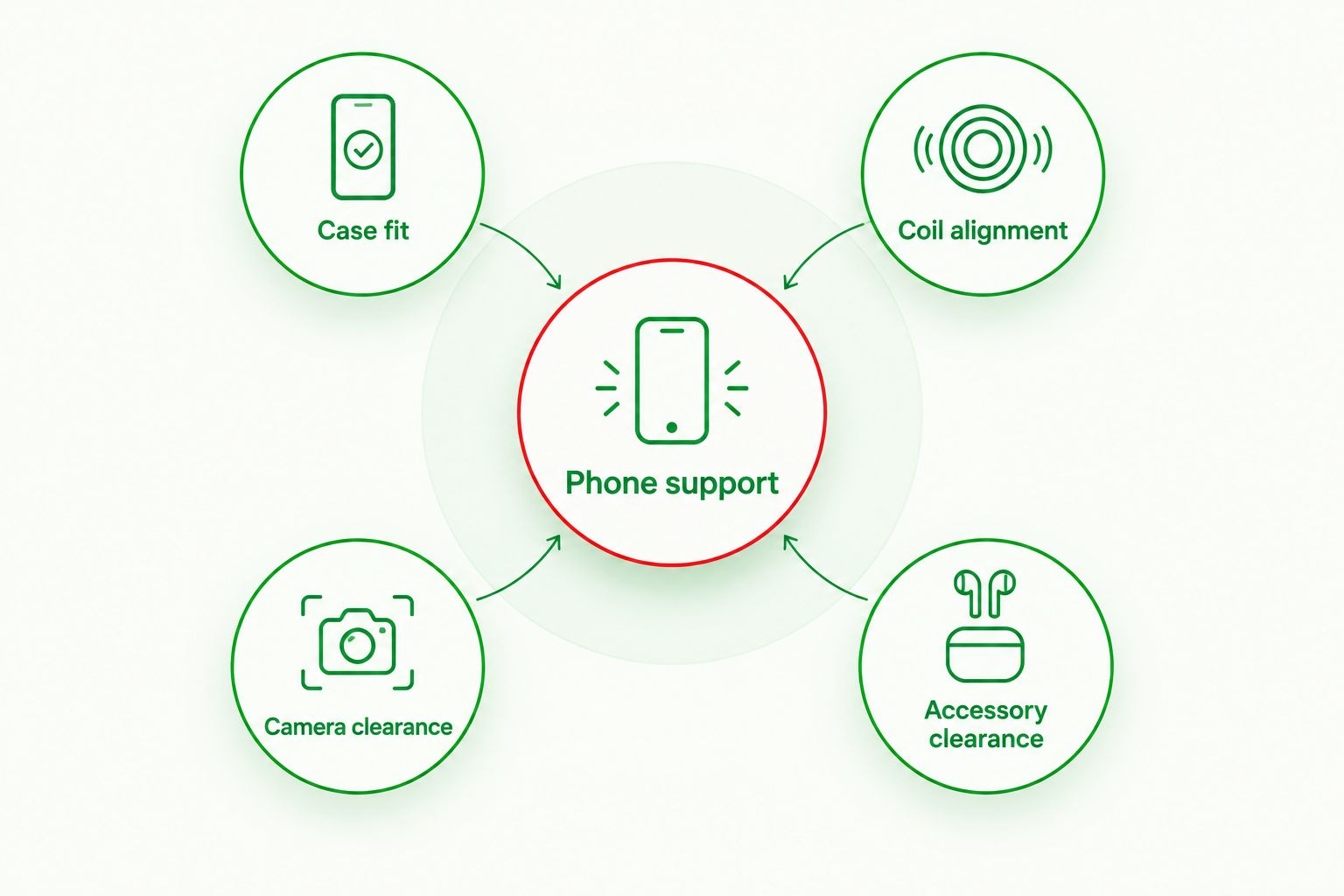
Check your 2026 purchase against the case you actually use. Compatibility with a bare phone is not enough if you intend to leave a thick case, wallet or grip attached throughout the day.
Do not buy on magnetic attachment alone. Look for explicit charging compatibility, and follow the manufacturer’s instructions about removing objects between the phone and charging surface.
What do capacity and charging figures actually tell you?
Battery capacity and charging output answer different questions. Capacity concerns stored charge or energy; output concerns the rate at which the charger can supply power under supported conditions.
Battery capacity: read mAh with its voltage
Milliamp-hours describe electric charge. 1,000 mAh equals 1 Ah, but that conversion alone does not tell you how much energy reaches your phone.
To compare energy, you also need the voltage associated with the capacity rating. A power bank’s cell rating and your phone battery’s rating are not a promise of an exact number of full charges.
Energy conversion, the charging method and phone use all affect the result. Treat a listing’s recharge-count claim as something that needs a stated phone model and test conditions, not as a universal outcome.
Energy capacity: understand Wh
Watt-hours measure energy. 1 Wh represents 1 W supplied for 1 hour, which explains why energy capacity and charging power are not interchangeable.
When the manufacturer provides both mAh and Wh, read them together. Do not turn a large mAh figure into an exact runtime or recharge count without the necessary operating information.
Charging output: separate wireless, wired and shared power
Read the wireless output specification for wireless charging and the port specification for cable charging. A prominent output figure on the packaging does not establish what every connection delivers.
For a 2026 comparison, record the charging mode beside each figure. Also check whether connecting another device changes the available output; do not assume each device receives the headline maximum simultaneously.
Why wireless power bank performance varies
The same pack does not deliver the same experience in every setup. These are the practical factors to check before blaming either the phone or the accessory:
- Supported charging mode: The phone and power bank must support a compatible mode; the pack’s maximum is not a guarantee for every phone.
- Alignment: A charging surface that shifts out of position can interrupt charging or reduce performance.
- Case and attachments: Obstructions can interfere with positioning or charging. Follow the accessory’s stated case requirements.
- Temperature: Phones and chargers can reduce or pause charging when temperature limits are reached.
- Phone activity: Navigation, calls and other active tasks consume energy while the battery receives power.
- Shared output: Charging additional devices can change how a power bank distributes its available power.
Compare supported conditions, not just the largest number. A clearly documented charging mode is more useful than an unexplained fast-charging label.
What should you check for a UAE workday or drive?
Think about where the pack will sit while charging. A comfortable desk setup can become awkward when you need to hold the phone, fit it into a mount or carry it with a pack attached.
For office use, check whether the combined phone and pack remain comfortable during calls. Also consider whether the power bank blocks the charging port or makes the phone unstable when placed on a desk.
For driving, arrange the charger and phone before setting off. Do not assume that a magnetic power bank is a vehicle mount, and do not handle or reposition it while driving.
Keep charging equipment out of direct sun and follow its operating-temperature instructions. A parked vehicle is not a suitable default storage place for a lithium-ion battery, particularly in hot conditions.
For travel during 2026, check your airline’s current power-bank rules before packing. Read the pack’s energy label and ask the airline about unclear markings rather than relying on a seller’s broad travel-friendly description.
Can a wireless charger work without a wall socket?
A wireless charger power bank can charge away from a wall socket because it has a rechargeable battery. A powered pad or stand needs its specified power source unless its documentation explicitly confirms battery operation.
Check how the product itself recharges. A USB connection, folding design or portable-looking shape does not prove that a battery is inside.
Can you use a wireless power bank while it is recharging?
Use a wireless power bank while it recharges only when its instructions explicitly permit that operating mode. Do not assume that separate input and output connections establish support for simultaneous charging.
If that feature matters at your desk, confirm it before buying. Otherwise, plan to recharge the pack separately and use the phone’s normal charging arrangement when a socket is available.
Is magnetic charging enough to confirm compatibility?
Magnetic attachment is not enough to confirm wireless charging compatibility. Your phone must support wireless charging, and the accessory must support a compatible charging mode.
Check the full combination: phone, case and charger. An accessory that attaches securely can still be the wrong electrical or physical match.
FAQ
What should I check first before buying a wireless charger power bank?
Check your exact phone’s wireless-charging support first, then confirm that the accessory contains a rechargeable battery. Next, check charging compatibility, case fit, output specifications and recharge requirements.
Will a wireless charger power bank work with every phone?
No, a wireless charger power bank will not wirelessly charge every phone. Your exact model must support a compatible wireless-charging method; a wired connection requires its own connector and charging checks.
Does a magnetic case add wireless charging to my phone?
No, a magnetic case does not add wireless-charging capability to a phone that lacks it. Magnetic attachment and wireless power transfer are separate requirements.
How many full charges will a wireless power bank give me?
The mAh rating alone does not establish an exact number of full phone charges. Battery voltage, energy conversion, charging conditions and phone use affect the energy delivered.
Can I leave my wireless power bank in the car?
Do not use a parked car as the default storage place for a wireless power bank, particularly in hot conditions. Follow the manufacturer’s storage-temperature instructions and keep the battery out of direct sun.
Is a wireless charging stand the same as a power bank?
No, a wireless charging stand is not a power bank unless its specifications explicitly confirm a built-in rechargeable battery. Check battery capacity and recharge instructions before choosing it for use away from sockets.
Should I keep a cable with my wireless power bank?
Yes, keep a compatible cable if the power bank supports wired output and you want an alternative charging connection. Confirm the port, cable and phone requirements rather than assuming every combination works.
One last thing
Test the complete setup before depending on it for a full day out. Attach the pack with your usual case fitted, confirm the charging indicator and check that the phone remains comfortable to hold.
Then check the less obvious task: recharging the power bank itself. Your 2026 buying decision is not complete until you know which connection and power supply that requires.